
High above the river Waal, on the edge of Nijmegen’s Valkhof Park, stands one of the Netherlands’ most historic sites. Roman soldiers once guarded the northern frontier of the empire here, while centuries later rulers such as Charlemagne and Frederick Barbarossa stayed on the same grounds. Today, this layered history forms the backdrop of the renewed Valkhof Museum – a museum that connects the past with contemporary life.
Nijmegen, the oldest city in the Netherlands, has long been shaped by its position on the borderlands of Europe. Rivers, trade routes and cultural exchanges turned the region into a meeting place for different peoples and ideas. That sense of connection and movement is central to the museum’s new identity.
Originally opened in 1999, the striking glass and steel building was designed by Dutch architect Ben van Berkel. More than twenty years later, the museum has undergone a major renovation and sustainability upgrade, while preserving the original architectural vision.
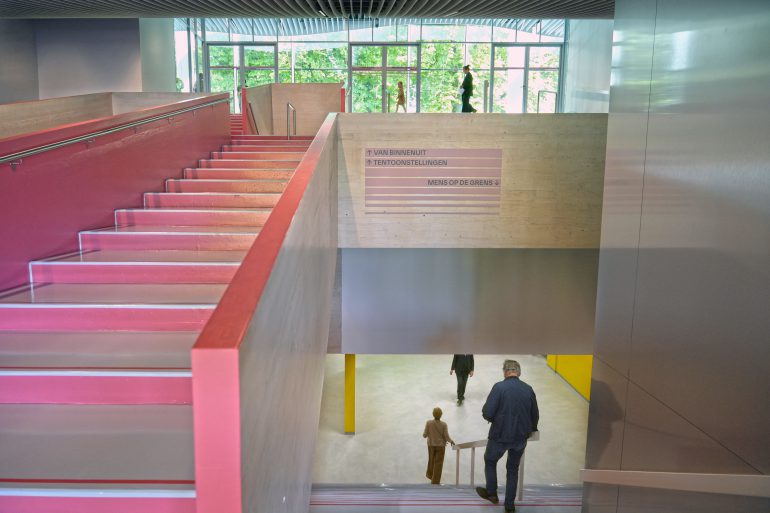
Visitors immediately notice the transformation. The entrance is brighter and more open, creating a stronger connection between the museum and the city outside. The café and museum shop now face a newly greened public square with a terrace, encouraging visitors to linger. Inside, a bold staircase in shades of pink, red and orange guides visitors through the building. Product and interior designer Ineke Hans gave the public spaces a lighter and more playful atmosphere.
But the biggest change is conceptual. Director Hedwig Saam sees the museum as more than a place where historical objects are displayed behind glass. ‘We want to be a museum that moves with its time,’ she explains. ‘A place where history speaks to the present.’
That vision comes to life in the new permanent presentation Where People Meet. Spanning more than 40,000 years of history, the exhibition takes visitors on a journey through stories from Nijmegen and beyond. Objects range from the world’s oldest toy figurine and a Roman cavalry mask to a Surinamese plantation diorama and footage of Nijmegen protests in the 1980s. Together, they explore themes such as migration, identity, conflict and power, issues that remain highly relevant today.
Contemporary art also plays an important role. In From with in, contemporary artists respond to emotions such as fear, hope and desire, using objects from the museum collection. Outside, the newly redesigned Kelfkensbos square will feature monumental sculptures by Spanish artist Fernando Sánchez Castillo, inspired by Nijmegen’s Roman past.
With its renewed building and forward-looking exhibitions, the Valkhof Museum offers international visitors a fresh way to experience Dutch history, not as something distant, but as a story that still shapes the world today.