
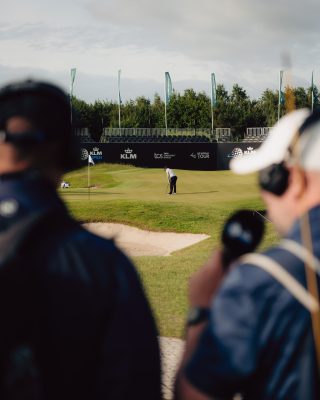
At most sporting events, the first sign that something important has happened is noise. A roar from the far side of a stadium. A sudden wave of applause from a stand. A collective groan rolling across the crowd. Golf is different. At a tournament such as the KLM Open, the drama is often happening somewhere else.
You may be standing by the 12th green, watching a Dutch favourite size up a putt, while the tournament leader is in trouble two holes away. You may have followed one player all morning, only to discover that the leaderboard has quietly reshuffled behind your back. Golf is a beautiful spectator sport, but it is not always an easy one. It spreads itself across acres of grass, bunkers, trees, water and whispered tension. That is where KLM Open Radio comes in.
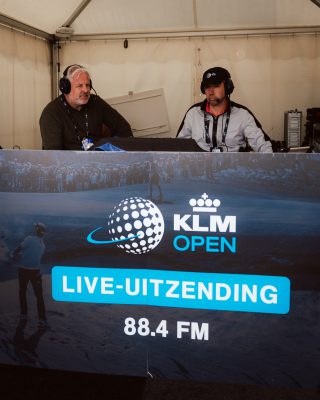
For two decades, KLM Open Radio has been one of the most charming and useful features of the Netherlands’ biggest international golf tournament. It is part commentary service, part clubhouse gossip, part rolling news operation and part love letter to the sport. More than anything, it gives the KLM Open a voice.
That voice is closely associated with Robbert Meeder, the NOS radio man whose fingerprints are all over the project. Meeder understands radio in the old-fashioned sense: immediacy, timing, atmosphere and the ability to know when to talk and when to shut up. In golf, that last skill is not a luxury. It is essential. A reporter beside the ropes must describe the tension without disturbing it. The best golf radio does not shout over the moment. It leans in and lets the listener hear it.
KLM Open Radio began in 2004, when tournament director Daan Slooter wanted to add something new to the visitor experience. At the time, event radio was still a familiar enough concept in the Netherlands. There were special broadcasts tied to sporting occasions and local events, including Radio Haarlem Honkbal Week, which served baseball fans during one of the country’s most beloved international tournaments. These stations had a practical purpose. They helped people on site understand what was happening around them.
But event radio also came with a problem: it needed a radio setup. Frequencies, transmitters, technical crews, licences, hardware, volunteers and a location. It was wonderful when it worked, but it was never simple. In the digital age, many of these specialist stations disappeared. The world moved to apps, streams, social media updates and video clips. In that sense, KLM Open Radio has become something rare: the last of the Mohicans.
That it survived says something about golf, but also about the people behind it. The KLM Open is a perfect setting for event radio because the sport creates the need. Spectators physically cannot see everything. They choose a group, a hole, a grandstand or a walking route, and then they rely on information to fill in the gaps. A leaderboard helps, but it does not tell you whether a player looked nervous, whether the wind suddenly picked up, or whether a missed putt was cruel, careless or simply unlucky.
Meeder and his team have spent years filling those gaps. The broadcast has grown from a clever add-on into a fixture of the tournament. Reporters follow key groups. Studio voices keep the story moving. Interviews, updates and live observations stitch the course together. On a good day, the listener feels not merely informed but accompanied. Oddly enough, Meeder’s voice is not to be heard – due to his position with the NOS, Robbert was always the silent parter in KLM Open Radio. Even now, following his announced retirement, he does not expect to play a vocal role saying, “The team is good enough and my voice is not needed”.
That is where John Woof also enters the story. Woof has been one of the people who understands the value of KLM Open Radio not only as a piece of media, but as part of the live event itself. For spectators, it can change the rhythm of the day. Instead of drifting between holes and checking scores on a phone, they can walk the course with context in their ears. For those listening remotely, it offers something television does not always provide: a sense of being inside the ropes, moving with the players and sharing the small moments between the big ones.
The most famous example remains Joost Luiten’s victory at Kennemer in 2013. As Luiten closed in on the title, KLM Open Radio opened the microphones around the final holes and let the scene breathe. Before the decisive putt, there was silence. Then came the roar. It was not a polished television drama. It was better than that. It was live sport caught in the act.
That matters because KLM Open Radio is not nostalgia for nostalgia’s sake. It is not a museum piece with a microphone. It is a practical solution to a real sporting problem, and one that still feels wonderfully human. In an era when every event seems to chase bigger screens, more data and louder entertainment, this little radio operation does something different. It whispers, explains, laughs, pauses and notices.
The 2026 KLM Open will be played from 4 to 7 June at The International near Amsterdam, once again bringing DP World Tour golf to the Netherlands. Thousands will come for the players, the course, the village, the drinks, the sunshine if the Dutch weather allows it, and the pleasure of following a tournament on foot.
But many will also come with something in one ear. Not to escape the event, but to get closer to it. That is the quiet genius of KLM Open Radio. It does not compete with the live experience. It completes it. To experience more of the KLM Open for yourself, tune in to klmopen.nl
Written by John Mahnen