
On Saturday, November 1, at the Residence of the Ambassador of Egypt, H.E. Emad Hanna, a reception took place on the occasion of the opening of the Grand Egyptian Museum, followed by a live streaming of the opening ceremony. All the guests were warmly welcomed by the Ambassador and he finished his words, saying that he hoped the guests will all have the opportunity to visit the Grand Egyptian Museum. Then we all enjoyed the spectacular inauguration Ceremony.
A total of 79 official delegations participated in the opening ceremony, including 39 delegations headed by kings, princes, and heads of state and government.
In the ceremony, which took about 1 hour, we could see among others, a musical symphony; a magical drone and laser show illustrating Orion’s Belt and how the museum’s design is connected to the pyramids; several speeches among others of the Dr. Farouk Hosny, former Minister of Culture; address by His Excellency President Abdel Fattah El-Sisi, President of Egypt; grand light, music, visual and firework show inaugurating the Grand Egyption Museum; the Obelisk and the Ramses scene, a show celebrating the Khufu’s Boat, etc. and the Finale: Tribute Show Honoring King Tutankhamun.
The GEM is one of the largest museums in the world, and the largest dedicated to a single civilization: ancient Egypt. Its subject matter spans some 7,000 years, from prehistory to the end of the Greek and Roman eras around 400 A.D.
“It is a great day for Egypt and for humanity. This is Egypt’s gift to the world. It’s a dream come true, after all these years, the GEM is finally and officially open,” said Nevine El-Aref, media adviser to the Minister of Tourism and Antiquities.
The initial cost for the more than 5-million-square-foot, triangular-themed structure about a mile from the iconic pyramids of Giza was estimated at $500 million, but the final price tag was more than double that. Costing over $1 billion, the project was funded through Egyptian resources and international cooperation.
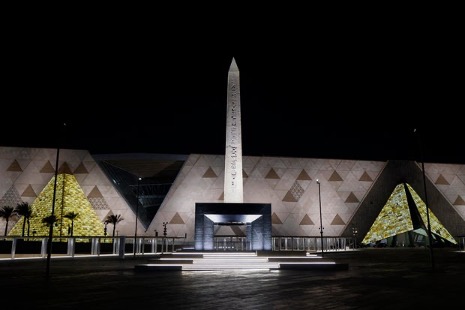
In front of the main entrance stands the imposing 53-foot-high Hanging Obelisk, the only such a structure in the world. The obelisk itself is about 3,500 years old, but it sits suspended overhead on a modern structure with a glass floor, so visitors can peer up and view its ancient inscriptions from an angle never before possible.Beyond is the Grand Staircase, with 108 steps bringing people up the equivalent of six floors to the main galleries, with colossal statues on view the whole way up.
The GEM has 12 primary exhibition halls, covering about 194,000 square feet. The number of artifacts on display has nearly doubled initial expectations thanks to Egypt’s wealth of antiquities, with officials saying about 100,000 items will be housed in the halls.
The museum’s triangular architecture radiates outward from its entrance toward the three main pyramids of Giza, aligning perfectly with their positions. Its walls and sloping ceilings follow the same lines, rising toward the pyramids’ highest points, but not exceeding the height of the ancient structures, out of respect for their builders.
The museum’s interior offers stunning panoramic views of the pyramids. The concept may sound simple, but it required a significant reshaping of the local topography, including the excavation and removal of some 79 million cubic feet of sand, which took workers seven months.
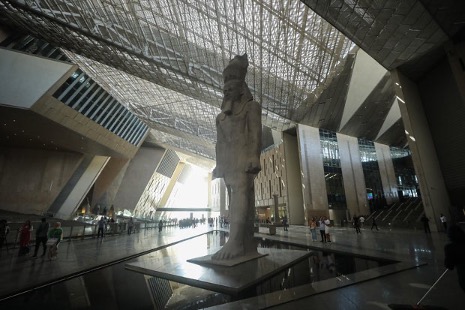
King Ramses II
In the entrance courtyard of the GEM, stands a massive, 3,200-year-old statue of King Ramses II. The statue was moved in 2006 from a busy square in central Cairo to a site near the Great Pyramids, where it stood awaiting the new landmark museum’s construction. The 83-ton statue’s journey took 10 hours, processing slowly through the streets of Egypt under heavy security as people watched on TV. Later Ramses was moved to a new permanent home, about 400 yards away, and the museum was built around it.
King Tut’s complete collection
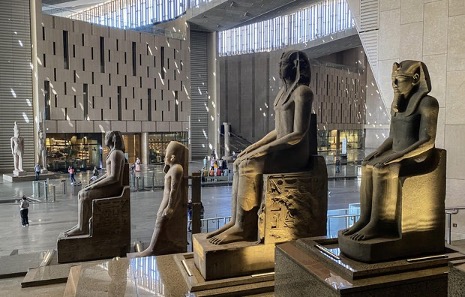
The GEM’s main attraction is the complete collection of the famous King Tutankhamun. All 5,398 items from the tomb of the 13th pharaoh of the 18th Dynasty of ancient Egypt, who ruled from around 1333 to 1323 B.C., will be displayed together in one place for the first time since they were discovered by Howard Carter in 1922. The new showroom is six times the size of the one that previously housed much of the Tut collection, at the old Egyptian Museum in central Cairo.
King Khufu’s Boats
The GEM also boasts the King Khufu’s Boats Museum, showing the 4,500-year-old boats that were designed to be used in the journey to the afterlife. The two royal boats were discovered in 1954 near the Pyramid of Khufu. It took experts more than 10 years to reassemble the first boat. It is now fully reconstructed and was moved to the museum in 2021. Visitors of the museum can also view the conservation work underway on the second one.
Scholars believe they were either used in Khufu’s funeral procession or they were intended for his journey with the sun god Re in the afterlife.
The long road to the Grand Egyptian Museum
The idea for a grand museum on this site in Egypt dates back more than 32 years. The government first allocated 117 acres for the project at the location in 1992.
At the very beginning of 2002, Egypt launched a massive international architectural competition to find a winning design for the museum. A total of 2,227 architects from 103 countries applied to submit designs, and by August of that year, 1,550 from 83 countries had submitted conceptual drawings.
A couple months later officials had whittled the options down to only 20 designs to put forward for a second stage. In July 2003, the prize – and the massive contract – was awarded to the Irish architectural firm Heneghan Peng.
The plan was originally for the museum to open in 2010, but a series of events, including financial crisis, political uprisings, the COVID-19 pandemic and regional wars, delayed the curtain raising.
Egyptian officials hope the new museum will boost the country’s tourism industry. They have predicted that the GEM will attract some 5 million visitors per year.
Written by Nanda Jagusiak-Monteiro