
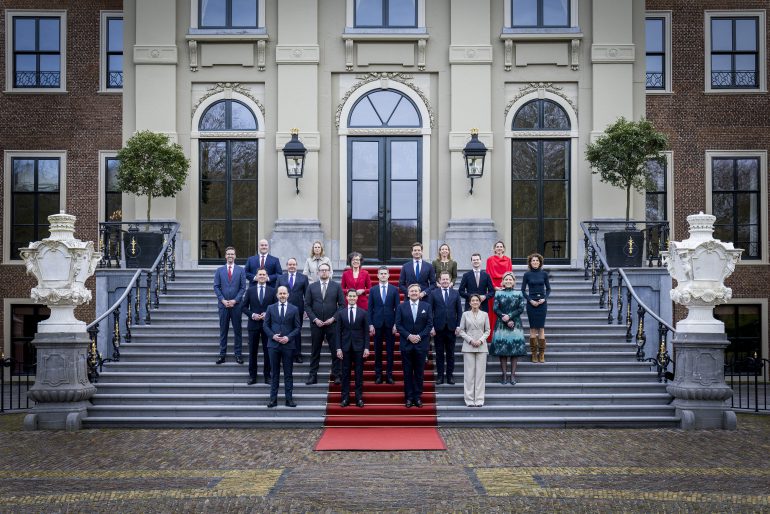
A new government steps in
The Netherlands has a new government. After weeks of coalition negotiations, Prime Minister Rob Jetten now leads a minority cabinet comprising D66, VVD, and CDA. Together, the three parties command less than a majority in the House of Representatives.
The cabinet was officially sworn in on Monday 23 February ahead of its first parliamentary debate, scheduled for Wednesday and Thursday, where Jetten faced his ‘baptism of fire’ before a House of Representatives already primed for confrontation. The government has adopted the motto ‘get to work’, signalling an intent to move quickly on its agenda.
But opposition parties are immediately sharpening their knives. PVV leader Geert Wilders posted a black image online reading ‘not my cabinet’. The road ahead for this minority administration is anything but smooth. Whether its plans will be actually implemented remains, as the Central Planning Bureau (CPB) notes, ‘highly uncertain’.
What the coalition agreement promises
The coalition agreement between D66, VVD, and CDA sets out an ambitious programme covering defence, housing, education, climate, and social policy.
On defence, the Netherlands is on course to meet the new NATO target requiring member states to spend 5 percent of their GDP on defence and certain types of infrastructure, according to calculations by the CPB.
Education will also receive additional funding, which the CPB projects will lead to higher-quality outcomes. On housing, the government has identified the chronic shortage as a major challenge to be addressed.
These are areas where the coalition looks to be tackling structural problems which have long been neglected. However, the agreement is built on a significant fiscal trade-off: to finance these investments, the government is cutting healthcare and social security budgets and accelerating the increase in the state pension age.
A minority government in a turbulent world
The structural challenge facing the Jetten cabinet extends beyond domestic politics. As the Social and Cultural Planning Bureau (SCP) observes, the Netherlands finds itself in a ‘turbulent geopolitical situation’ which demands political agility.
A minority government must build ad-hoc majorities for each piece of legislation, making comprehensive structural reform politically difficult and increasing the risk of exactly the kind of stopgap measures. The risk is a government operating under constant parliamentary pressure defaults to patching rather than reforming; accumulating short-term fixes which solve immediate political problems while making underlying structural issues harder to address.
‘I would be very wary of stopgap measures,’ SCP director Karen van Oudenhoven says. ‘Examine every policy proposal you have before you and consider: what consequences will this have for different groups in society? This will prevent you from having to make all sorts of adjustments later on for people who get into trouble.’
Trust, delivery, and the democratic stakes
The SCP’s assessment ends on a note transcending policy analysis. ‘Unfulfilled promises erode trust,’ the SCP report states. This is especially acute when cuts are implemented quickly but the promised benefits, such as reduced healthcare demand, more resilient communities and healthier workers, materialise slowly or not at all.
The SCP argues citizens should be more meaningfully involved in policymaking, such as through citizen panels, as a way of rebuilding the relationship between government and governed. The Netherlands, like many European democracies, is experiencing a period of deep political volatility.
The rise of parties like Wilders’ PVV reflects, in part, a feeling among significant sections of the electorate that the political establishment does not understand or care about their material circumstances. If the Jetten cabinet’s plans do indeed widen inequality while failing to deliver on promises of better public services, that erosion of trust will have consequences – not just for this government, but for Dutch democracy more broadly.
Written by Jason Reed