
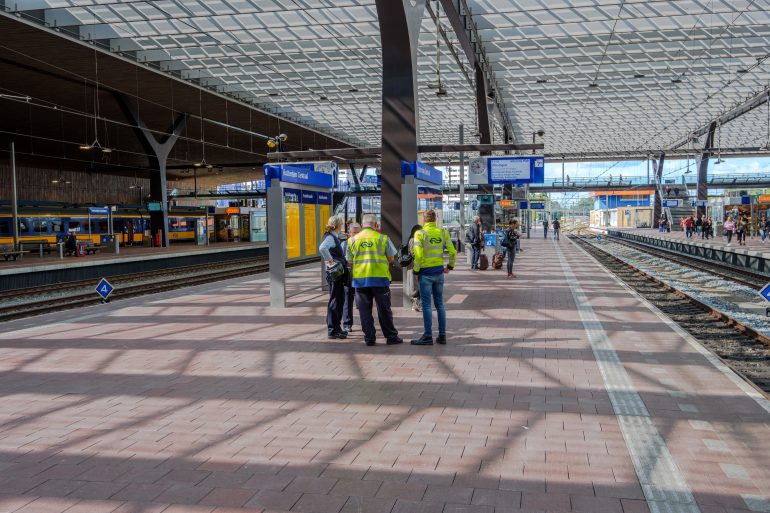
For the first time in its history, the Dutch rail operator Nederlandse Spoorwegen (NS) will allow a select group of its employees to carry batons on duty, a decision that underscores how sharply safety concerns on trains and at stations have intensified.
The measure comes after years of rising aggression against railway staff. According to NS figures published this month, 1,132 incidents of aggression were recorded in 2025, up from 1,095 the year before. Although the number of physical injuries fell slightly, employees still face an average of three aggressive incidents per day. Increasingly, it is not conductors on trains but enforcement officers of the Safety & Service department, the so-called boa’s (special investigating officers) who are on the front line. These mostly work at stations, forming a first line to keep the actual trains safe, by removing people who behave aggressively from stations before they get on board.
‘It is completely unacceptable,’ says Itai Birger, director of social safety at NS, in remarks reported by broadcaster NOS. Birger stressed that the baton is intended as a last resort and must always be used responsibly. ‘It is, of course, very important that this is always done proportionately.’
Beginning this week, 75 of the approximately 680 NS enforcement officers will undergo six days of training. They are based in Rotterdam, The Hague, Zwolle and ’s-Hertogenbosch, and will also operate in surrounding stations. If they pass their certification exams, the first officers are expected to carry batons during their shifts by the end of April.
The pilot will run for one year. During that time, NS will compare officers carrying batons with a control group at the same stations who are not equipped with them. ‘This way, we can properly assess the baton’s effects,’ an NS spokesperson told NU.nl. Although the Dutch cabinet initially approved a two-year trial, NS believes one year will provide sufficient data to determine whether the measure improves workplace safety.
The training focuses not only on technique but also on judgment. Officers will learn when they may and may not use the baton, how much force is justified in a given situation, and how to de-escalate conflicts before they reach that point. Boa’s already have the authority to use force and detain individuals when necessary. Until now, however, they could rely only on their physical presence and limited equipment. The baton adds what NS describes as ‘an additional tool’.
The decision did not come lightly. NS applied for permission last summer, acknowledging internally that it would have preferred not to arm staff. But incidents involving threats with knives, intoxicated passengers and individuals with severe behavioural problems have become more common. Officers report facing increasingly unpredictable situations, particularly during evening and night shifts.
NS hopes the baton will function primarily as a deterrent. The company points to earlier safety measures, including the rollout of body cameras for enforcement officers and, later this year, for all senior conductors, as evidence that visible tools can reduce escalation. In parallel, the Ministry of Infrastructure and Water Management, together with the track managing company ProRail, has launched a €20 million action plan to improve safety at stations, focusing on lighting, surveillance and staffing levels.
The introduction of batons has nevertheless sparked debate. Supporters argue that railway staff deserve adequate means to defend themselves in a society where public aggression appears to be increasing. Critics caution that visible weapons could escalate rather than calm tense encounters, and question whether a transport operator should expand its enforcement role instead of relying more heavily on police presence.
For NS employees, the issue is more immediate than theoretical. Many say their primary concern is simple: to arrive home safely after a shift. As one enforcement officer told reporters during training sessions in Amersfoort, the baton provides ‘just a bit more distance’ in situations that can turn volatile in seconds.
By this time next year, data from the pilot will reveal whether that extra distance translates into measurable improvements in safety. Until then, the sight of a baton on a Dutch railway platform will signal a new and more assertive chapter in the country’s approach to public transport security, one shaped by necessity, scrutiny and the delicate balance between authority and restraint.
Written by Priyanka Sharma