
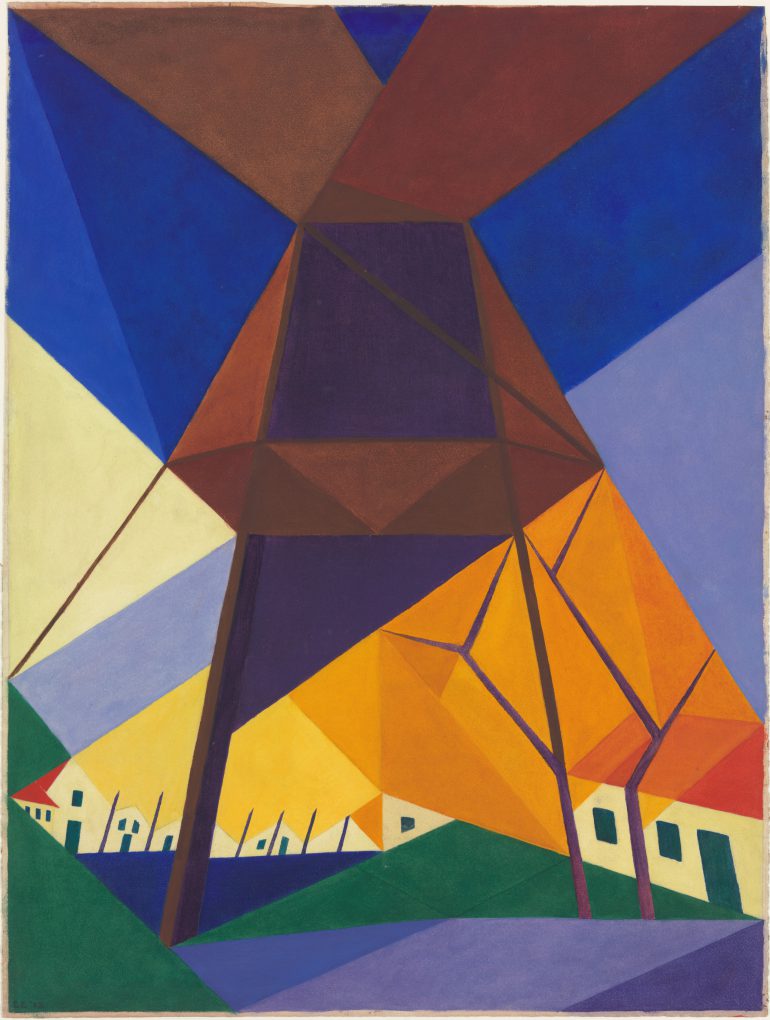
For the first time in 33 years, Stedelijk Museum Schiedam will be presenting a solo exhibition by Lou Loeber (1894-1983), whose vibrant, socially engaged yet accessible work made her into a unique artist. The exhibition marks the launch of a programme about women artists from the 1970s who worked in an abstract style and to whom Loeber was an important source of inspiration.
Developing her own style
From an early age, Lou Loeber knew she wanted to become an artist. Growing up in a progressive family, she was given the space she needed to develop her talent. In the 1920s, she developed a style of her own in which she combined abstraction with recognisable depictions. Although she was inspired by the work of Wassily Kandinsky and De Stijl, she always remained true to her own vision. With characteristic vivid colours, geometric shapes and black contours she intended her work to convey a universal visual language that everyone could understand.
Loeber furthermore designed a system to create multiple versions of a single work, applying the modernist ideal of mass production to the visual arts. She also produced her work in various media, and together with her husband, artist Dirk Koning, she established an art lending service in 1932 to rent out works at an affordable rate.
Art for everyone: accessible and connective
Despite her recognisable style, Loeber wanted her works to be impersonal. She was, after all, interested in creating universal art, not in individual expression. She used her designs – interiors, landscapes, still lives, and portraits – to experiment with colour, form and composition. She was constantly searching for harmony between abstract and figurative art, which she hoped would contribute to realising a better and more socially just world.
After the Second World War, Loeber continued to make art inspired by her socialist ideals, even though she had lost all hope that a more equal, socialist society would ever actually be realised. She nonetheless never lost her conviction that art had to be comprehensible as well as accessible. This ideal perfectly matches the ambitions of Stedelijk Museum Schiedam.
Private collections
Last year, the Stedelijk Museum Schiedam issued a call to the public: anyone who owned a work by Loeber was invited to come forward. As a result, eight works by Loeber from private collections have been added to the selection for the exhibition.
The museum also managed to bring together three paintings that Loeber made of the Schiedam windmill De Walvisch. These works clearly illustrate Loeber’s search for simplification. In each version, the windmill and the surrounding landscape change subtly, with fewer details. This quest for simplification ultimately led to her characteristic colourful and geometric style.
On show until 27 September
stedelijkmuseumschiedam.nl