
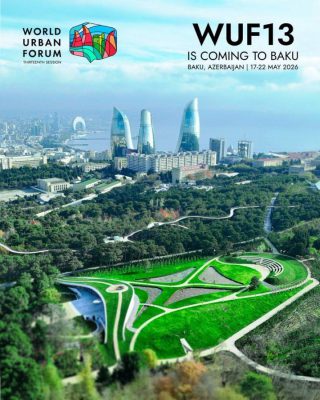
With the 13th World Urban Forum (WUF13) set to take place in Baku from 17-22 May 2026, Azerbaijan is preparing to present its urban transformation journey on a global stage. The country’s cities embody a unique continuity-linkingancient settlement traditions with the rapid modernization of the industrial era and an emerging vision of smart, sustainable urban development. As one of the world’s key platforms for dialogue on urban futures, WUF13 will highlight issues such as resilience, housing, and sustainable growth-challenges increasingly shared across regions, including Europe and the Netherlands.
A Deep Urban Legacy: From Rock Art to Medieval Cities
Azerbaijan’s urban story begins thousands of years ago, rooted in some of the earliest traces of human civilization. The archaeological landscape of Gobustan preserves prehistoric rock engravings that document early human life, creativity, and settlement patterns. Recognized as a UNESCO World Heritage Site, Gobustan illustrates the depth of Azerbaijan’s cultural foundations and its long-standing relationship between people and landscape.
The medieval period further shaped the country’s urban identity. The historic core of Icherisheher (Old City) of Baku,enclosed within fortified walls, stands as one of the most significant heritage ensembles in the region. Monuments such as Maiden Tower and the Palace of the Shirvanshahs reflect a synthesis of architectural traditions shaped by centuries of trade, cultural exchange, and political continuity.
Cities such as Shamakhi, Ganja, Shaki, and Shusha developed sophisticated urban systems centered around caravanserais, marketplaces, mosques, and bathhouses. These cities were not only commercial hubs but also early examples of human-centered planning, featuring neighbourhood structures, water systems, and integrated public spaces. The mountain settlement of Lahij is notable for its preserved urban fabric and early engineering solutions, including advanced water and sanitation systems dating back more than a millennium.
This era is also marked by Azerbaijan’s tradition of fortified architecture and mountain strongholds, which played a key role in settlement defence and organization. Among them, Alinja Fortress in Nakhchivan – often referred to as the “Machu Picchu of Azerbaijan” — stands out as a striking example. Together with other castles and fortified settlements, these sites reflect a model in which security, geography, and community life were closely interconnected.
The First Oil Boom: Birth of a Modern City
The discovery of oil in the late 19th century marked a turning point in Azerbaijan’s urban trajectory. Baku rapidly transformed into one of the world’s earliest industrialized cities, attracting European architects, engineers, and entrepreneurs.
This era introduced grand boulevards, eclectic architectural styles, and landmark civic buildings reflecting the ambitions of a booming oil economy. Iconic structures such as Ismailiyya Palace, Mukhtarov Palace, and the former Baku City Duma building embody Beaux-Arts and Neoclassical influences, signaling Baku’s emergence as a cosmopolitan urban center. Infrastructure expanded significantly, with tram networks, public parks, and modern residential developments reshaping urban life and laying the foundation for later large-scale planning approaches.
From the mid-20th century, urban development entered a phase of large-scale industrialization and state-led planning, particularly in Baku and other growing cities. Urban design emphasized functional zoning, mass housing, wide boulevards, and industrial and residential districts. Monumental civic buildings such as Government House and Gulustan Palace reflected the architectural style of the era.
Contemporary Urban Development: Heritage, Innovation, and Global Aspirations
In the 21st century, Azerbaijan’s urban landscape has entered a new phase defined by bold architectural experimentation and global engagement.
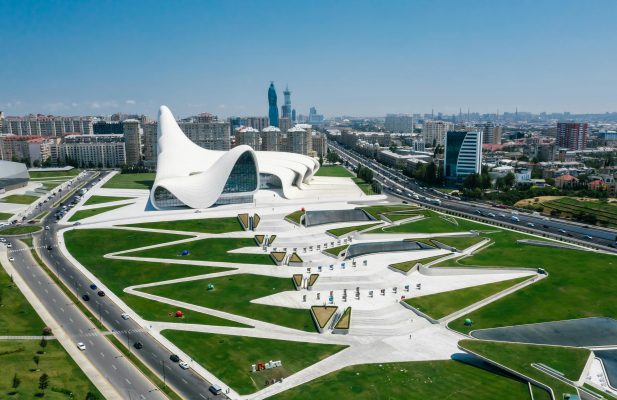
Modern Baku has become a showcase of internationally recognized design, blending contemporary aesthetics with cultural symbolism. The Heydar Aliyev Centre, designed by Zaha Hadid, stands as one of its most iconic landmarks. Its fluid, wave-like form departs from rigid architectural conventions and reflects Azerbaijan’s aspirations toward innovation and openness. The Flame Towers symbolize the country’s historical association with fire and energy, while theAzerbaijan National Carpet Museum integrates intangible cultural heritage into contemporary architecture.
Large-scale developments such as Port Baku, Deniz Mall, Baku Crystal Hall, Baku Convention Center, and Crescent Development illustrate the city’s evolution into a multifunctional hub for commerce, leisure, and international events. These projects combine engineering precision with distinctive design, reinforcing the city’s role as a platform for sustainable urban living and architectural innovation.
Other cities are also undergoing gradual modernization and urban renewal. Ganja is developing new public spaces and infrastructure to improve livability, while Sumgayit is transitioning from an industrial center into a more diversified city with expanding residential areas and green infrastructure. In Gabala, Shamakhi, Nakhchivan, and Lankaran,reconstruction and heritage-led development combine historical preservation with modern planning, strengthening local identity while improving infrastructure and public services.
Across these initiatives, increasing emphasis is placed on green design, public spaces, and environmental restoration – principles that gained further visibility during Azerbaijan’s hosting of COP29.
Urban Housing and Growth: Addressing a Global Challenge
As housing remains one of the most urgent urban challenges worldwide – and a central theme of WUF13 – Azerbaijan’s experience offers relevant case studies in managing rapid urbanization while advancing sustainability and livability.
Baku White City is among the most significant regeneration projects, transforming a former industrial zone into a modern, mixed-use district with green infrastructure, residential areas, and commercial spaces. It demonstrates how post-industrial land can be reimagined as a sustainable urban environment.
Sea Breeze is another example, integrating residential living with tourism and recreation along the coast. Its mixed public-private development model illustrates alternative approaches to housing delivery and coastal urban planning.
Together, these projects highlight how Azerbaijan is diversifying its housing strategies-combining regeneration, innovation, and investment to respond to demographic pressures and evolving lifestyle demands.
Sustainable Reconstruction in the Liberated Territories
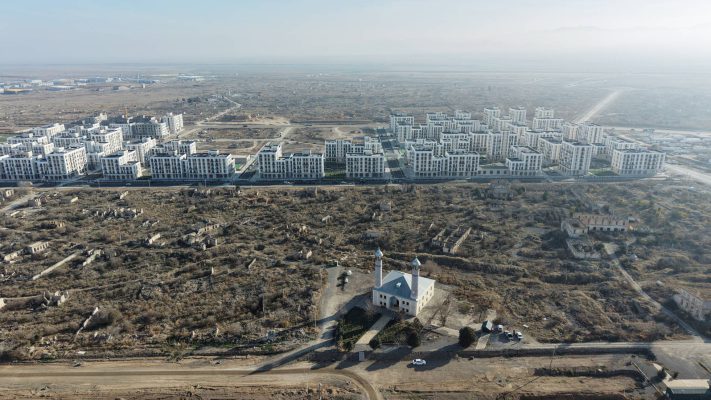
The most ambitious dimension of Azerbaijan’s recent urban agenda is unfolding in its liberated territories. These regions are being rebuilt from the ground up as part of The Great Return program, aimed at resettling displaced communities and restoring full economic and social life through smart city and smart village approaches.
Aghali Smart Village in Zangilan is a flagship example. It integrates renewable energy systems, digital governance, and smart agriculture, serving as a model for future rural development. Large-scale reconstruction and master planning are underway in Aghdam, Fuzuli, Jabrayil, and Kalbajar, where new urban layouts, residential districts, and infrastructure are being developed according to contemporary planning principles.
Infrastructure expansion is equally transformative. New international airports in Fuzuli, Zangilan, and Lachin,together with highways, tunnels, and transport corridors, are reconnecting previously isolated regions. These investments strengthen Azerbaijan’s role in the emerging Middle Corridor, enhancing connectivity between Europe and Asia.
Cultural restoration is also central. The revitalization of Shusha, a cultural capital of Azerbaijan, and the restoration of numerous historical, religious, and architectural sites reflect a commitment to preserving heritage while rebuilding modern urban life.
Azerbaijan and the Netherlands: A Shared Vision at WUF13
As WUF13 brings together global urban thinkers, Azerbaijan’s experience offers important points of convergence with countries such as the Netherlands. Both are deeply engaged in addressing spatial constraints, climate adaptation, and housing demand through innovation and planning excellence. While the Netherlands is internationally recognized for its expertise in water management and compact urban design, Azerbaijan demonstrates a complementary trajectory characterized by rapid transformation, large-scale regeneration, and experimental smart city development. Together, these perspectives contribute to a broader global dialogue on resilient, inclusive, and sustainable cities.
In this context, the participation of the Netherlands through an official delegation, alongside representatives from cities, academia, and the private sector, would be highly valuable in laying the groundwork for future cooperation and opening new pathways for collaboration in urban planning, innovation, and sustainable development.
Conclusion
Azerbaijan’s urban evolution reflects both continuity and reinvention. Its built environment embodies a dynamic dialogue between heritage and innovation. As the world gathers in Baku for WUF13, Azerbaijan stands not only as a host but also as a case study in urban transformation. Building on the successful hosting of COP29, WUF13 is set to become another major milestone in Azerbaijan’s growing role as a host of major international events.