
How recent research enriches the 350th anniversary year
Three and a half centuries after his death, Michiel de Ruyter continues to capture the imagination. Yet our understanding of this naval hero remains incomplete. Recent historical research has shed new light on his life and times, not through dramatic discoveries, but through careful attention to small details, passing remarks, and long-neglected sources. Two findings are particularly striking: the rediscovery of the so-called “freshwater war” (zoetwateroorlog) during the Disaster Years of 1672–1673, and the clarification of the long-standing mystery surrounding the burial of De Ruyter’s entrails in Syracuse.
A war hidden between the lines
The freshwater war did not emerge from a major research project, but from a single, seemingly incidental sentence. In a letter written by an English spy, Frits de Ruyter de Wildt casually remarked that the Dutch fleet was poorly manned and poorly armed. It was not his main point, merely a remark between the lines, yet it caught the attention of historian A. Doedens to initiate further investigation.
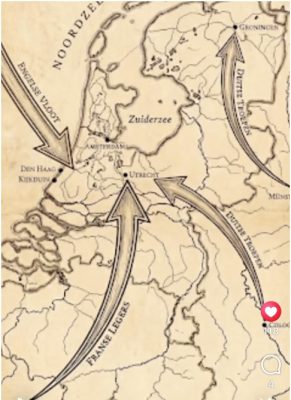
If the fleet was indeed undermanned and under-equipped, where had the men and the guns gone? The answer lay not at sea, but on inland waters. During the French advance of 1672, a large part of the Republic’s naval strength had been redeployed to rivers, lakes, and flooded polders. Sailors and marines, together with their artillery, were placed aboard small, shallow-draught vessels known as “uytleggers”, which could operate in waters inaccessible to large warships.
Under De Ruyter’s command, a prolonged and highly mobile conflict was fought on freshwater, the longest naval campaign in Dutch history. New tactics were developed, unprecedented cooperation between navy and army took shape, and even a thousand pairs of skates were procured for winter operations. The sovereignty of the Dutch Republic was at stake, and it was defended not at sea, but in the polders.
Another mystery: Syracuse
Equally fascinating is a second issue illuminated by recent research: the burial of De Ruyter’s entrails. For centuries, biographies treated this matter rather vaguely. It was known that De Ruyter died in 1676 in the Bay of Syracuse, that his body was embalmed and transported to the Netherlands, and that his entrails were buried locally, but where exactly remained unknown.
For a long time, historians assumed that there had been no opportunity to request papal permission to bury Protestant remains in Catholic soil. The Michiel de Ruyter Foundation decided to re-examine this assumption and pursued the question with patience and persistence. After nearly a year of research in the Vatican Archives, the answer finally emerged: De Ruyter’s entrails were buried next to the “small house of the Senators” in Syracuse.
Commemorating with new knowledge
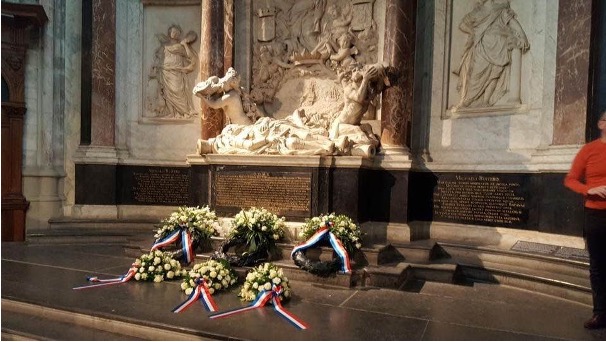
These discoveries underpin a series of commemorations in 2026, marking the 350th anniversary of Michiel de Ruyter’s death. On 21 February 2026, a commemorative event will take place in Amsterdam. In late April, a program will follow in Syracuse, including a symposium, an ecumenical service, the unveiling of a memorial plaque, a wreath-laying ceremony, and a reception hosted by the Baron.
Registration for the Amsterdam event is available via deruyter.org. Registration for the Syracuse program in April is also open, but participants are advised to book travel and accommodation well in advance. Donations to the Michiel de Ruyter Foundation support both our research and our commemorative events and are greatly appreciated.
Written by Frits de Ruyter de Wildt