
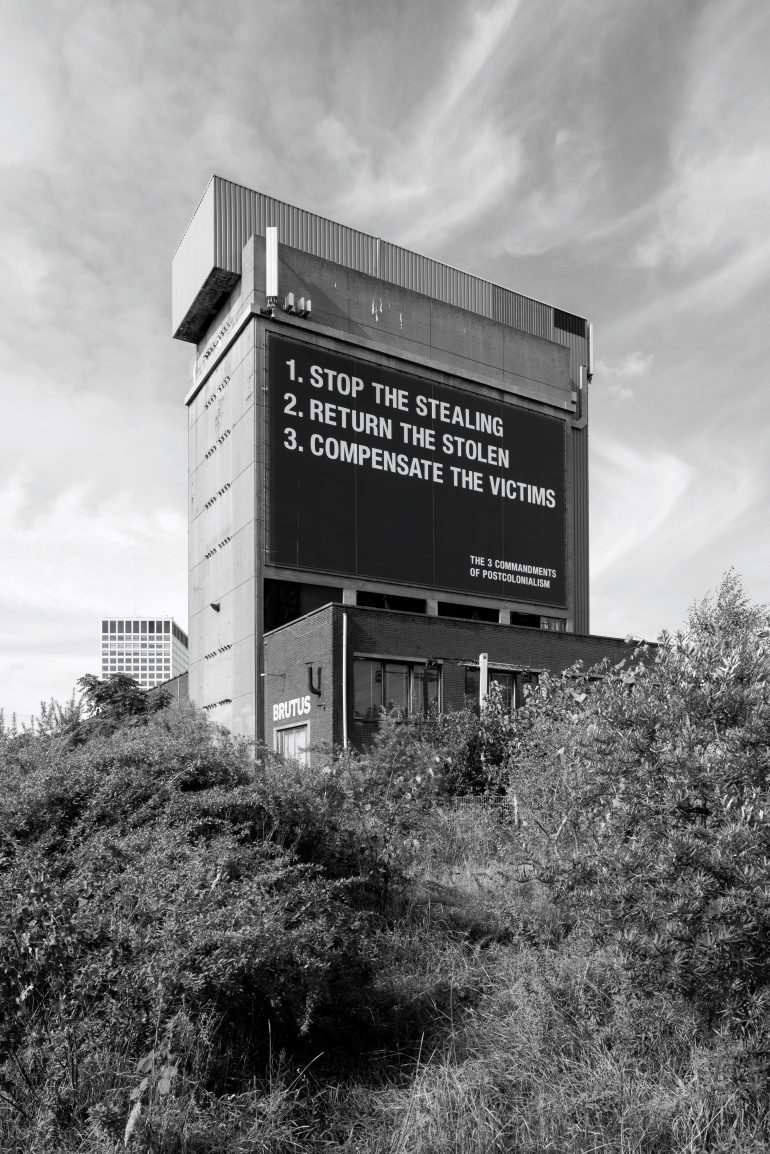
War, violence and wealth are often discussed as separate issues. In the work of Spanish artist Santiago Sierra, they are closely connected. His exhibition DEATH & MONEY, on view at Brutus in Rotterdam until 20 December, examines how political power, economic interests, labour and violence intersect.
The exhibition brings together seven monumental works spanning Sierra’s practice. Rather than offering a straightforward political statement, Sierra uses performance, installation, text and repetition to make systems of power tangible. His work often places real people and real structures at the centre, asking who holds power, who carries its consequences and what role individuals play within these systems.
Among the works on view are performances in which the names of people killed or disappeared through state violence are read aloud. In 1549 State Crimes (2007), Sierra recites the names of 1,549 people who disappeared or were killed by order of the Mexican state between 1968 and 2007. For another work, The Names of Those Killed in the Syrian Conflict Between the 15th March 2011 and the 31st December 2016 (2017), it took eight days to read the names of 144,308 victims of the Syrian civil war.
A new durational performance, Israeli State Crimes in Palestine since 14 May 1948, was presented in September in collaboration with A/POLITICAL in London, and streamed internationally, including to Brutus and other cultural institutions. The performance consists of a continuous reading of the names of Palestinians killed in historic Palestine by the Israeli state, its forces and settlers since 14 May 1948. The list was compiled from a range of established sources and archives, while its organisers emphasise that gaps remain because records have been destroyed, restricted or never created. The project is part of Sierra’s longer series of works addressing state violence through duration and repetition.
Sierra’s work has also moved beyond the walls of the exhibition. Since mid-September, Rotterdam’s streets and public spaces have carried another intervention: The Three Commandments of Post-Colonialism: STOP THE STEALING, RETURN THE STOLEN, COMPENSATE THE VICTIMS. The statements appear in Dutch, English and French – the languages of historically major colonial powers – on posters, digital screens and a large banner on the façade of Brutus.
The intervention directly addresses colonial dispossession and historical injustice. In Rotterdam, the campaign takes on an additional local dimension: as a former base of the Dutch East India and West India Companies, the city played a major role in the transatlantic slave trade. Thus, Rotterdam’s wealth is historically intertwined with colonial violence.
The exhibition does not offer easy answers. Instead, it asks us to consider our own position within the systems it exposes and places the message right in front of the visitor: in the art space, in performance and in the streets of Rotterdam.
Until 20 December