
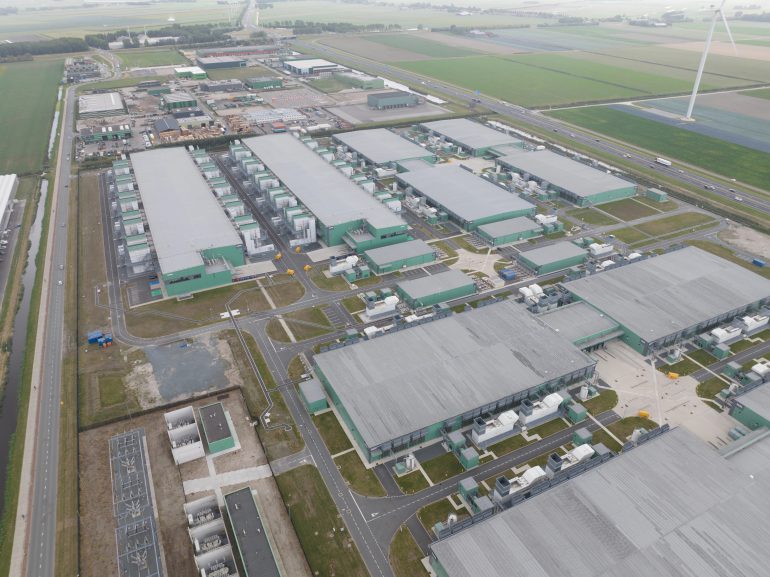
Plans for an Equinix data centre in Amsterdam-Zuidoost have reignited debate about the infrastructure behind the Netherlands’ digital economy. A group of residents opposing the Amstel III development question its demands on electricity and drinking water, while its supporters point out that mitigation measures are in place, as well as concomitant community benefits and the wider picture of Europe needing to keep up with AI development.
According to NOS, 500 people joined the opposition campaign, while 400 submitted objections to the environmental authority on the draft environmental permit. These disagreements over a single project reflect a wider national and global debate about whether we should welcome investment and upgrade our utilities systems to meet the demands of the age, or turn away new developments and technological advancements.
Infrastructure for everyday life
The benefits of the proposed data centre extend beyond the technology companies using the buildings. Data centres support a wide range of services, ranging from online banking to business software to communication services. Their computers also provide the processing capacity needed to develop and run artificial intelligence.
Michiel Eielts, Benelux director for Equinix, told NOS that Dutch businesses and the national government would together use more than half the proposed facility’s capacity. This account challenges the assumption that an American operator – Equinix is based in California – necessarily means that the infrastructure serves only US interests.
For a small business, renting computing capacity provided by data centres makes it possible to use sophisticated software without building and maintaining its own server facility. That lowers practical barriers to developing new products, reaching new customers and helping the Dutch economy grow.
Putting electricity use in perspective
Statistics Netherlands (CBS) reports standalone data centres consumed 4.6 percent of Dutch electricity in 2024, up from 3.3 percent in 2021. That is a substantial and growing share, which underlines the skyrocketing demand for computing capacity as the rollout of AI technology accelerates through the economy.
Efficiency makes a difference. The International Energy Agency (IEA) puts the share of electricity used for cooling data centres at about 7 percent in efficient hyperscale facilities (the very large sites used for AI and cloud computing). The figure exceeds 30 percent in less efficient enterprise data centres. Modern facilities can reduce the overhead involved in providing computing services, even as growing demand pushes raw consumption upwards.
Water use depends on design
Water consumption is a key pillar of data centre opposition, and the Equinix project is no different. The environmental authority puts maximum annual drinking water demand at one billion litres for all four towers. Equinix estimates up to 274 million litres for the first tower as a projected maximum requirement.
However, heavy water consumption by data centres is avoidable. Microsoft has developed cooling designs which circulate water in a closed loop without evaporating it. It says these designs eliminate water consumption for cooling. Microsoft also reports rainwater collection at some Dutch facilities, showing that cooling requirements need not always translate directly into demands on drinking water. This demonstrates technological improvements can swiftly address even the most important objections of data centre opponents.
Protecting homes while enabling growth
Despite concerns about data centres preventing the construction of housing nearby, NOS reports electricity capacity has already been reserved for 2,500 planned homes nearby. The environmental authority says Equinix is initially building just one tower. Future expansions depend on grid capacity.
Amsterdam has negotiated arrangements for using waste heat from servers to heat the surrounding buildings, offering shared benefits for nearby residents.
Investing in the future
The Dutch government’s international AI strategy, published in July, calls for stronger European computing infrastructure and cooperation on research and innovation. These ambitions require physical facilities and investment in utilities infrastructure.
Residents rightly raise questions about individual developments. But thinking of data centres simply as consuming resources overlooks the services and opportunities they make possible. The Netherlands’ capacity to build a growing and innovative economy increasingly depends on its willingness to allow investment in the cutting-edge infrastructure that powers it.
Written by Jason Reed