
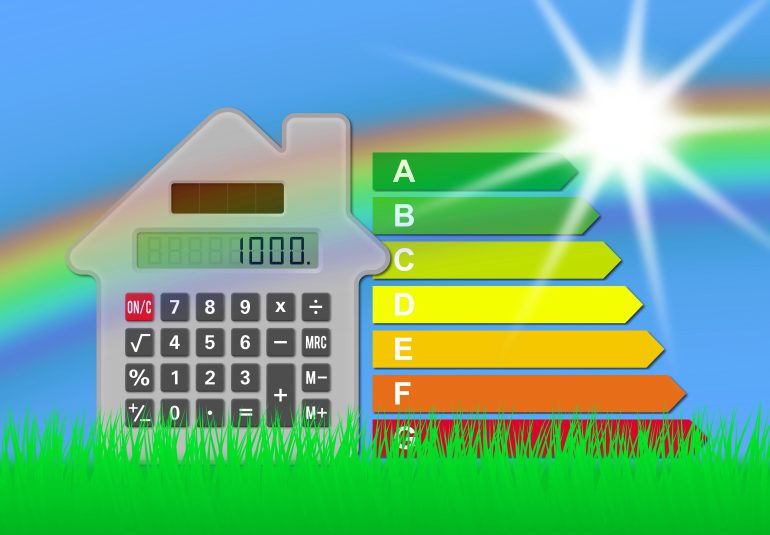
A higher home energy label is a sign of better environmental impact, as well as of improved energy living conditions. But better energy labels also have an effect on the financial aspects of home ownership: not only by providing lower energy bills, but – increasingly, nowadays – by allowing for better mortgage interest payments and better market resale prices. Over the long term, having a better energy label can bring substantial economic benefits to owners.
Energy labels are a ranked assessment of how energy-efficient a home is. They measure how much fossil-fuel energy a house consumes per square meter, considering system requirements for insulation, cooling, heating, ventilation, hot water, etc. Ratings range from A (very efficient) to G (very inefficient). In 2025, about 17.8 percent of owner-occupied households in the Netherlands (around 850.000 homes) were assigned E, F or G labels, which means higher energy costs.
But increasingly, a lower home energy label can also mean a higher mortgage interest rate, with more banks calculating loan payments based on this factor. According to mortgage expert Oscar Noorlag, quoted by AD newspaper, the interest rate difference between the highest and the lowest energy label currently lies around 0.18 percent. While that may not seem particularly large at first glance, it ends up being substantial over the course of an entire mortgage, which may run for as long as 30 years. For a mortgage of €375.000, the interest rate difference in payments between energy labels A and G can be €16.000 gross over the course of 30 years, as analysed by financial advisory firm Van Bruggen. This amounts to €44 per month or €533 per year.
The practice of discounted interest rates for more energy-efficient homes is not entirely new, but the amounts are increasing across the label spectrum. In the Netherlands, banks like ING and ABN AMRO already have differentiated rates, and more banks are expected to follow suit in the future. The reason is that banks are encouraged by European regulations to make their mortgage portfolio more sustainable, so more efficient homes get better rates. In principle, the entire chain is thus pushed towards energetic efficiency, by banks and homeowners alike. In times of higher energy price fluctuations, like recent ones related to the closure of the Strait of Hormuz, chasing home energy efficiency is therefore a sound economic decision, either by acquiring a new home or by improving the energy labels of an existing one.
After all, making property more sustainable brings the triple economic benefit of lowering mortgage interest rates, decreasing energy prices and increasing home values, sometimes by considerable amounts. According to mortgage broker De Hypotheker, a €650.000 home can increase its value by €100.000 when it is upgraded to the highest efficiency rating. This means an overall profit even when accounting for improvement costs – for which there are subsidies available in any case. For example, the National Heat Fund (Nationaal Warmtefonds) offers a loan with low interest rates for energy-saving home improvements like insulation, solar panels and heat pumps. With it, homeowners and homeowners’ associations (VVEs) can borrow between €1000 and €28.000 (depending on income); if income is below €60.000 per year, the Fund guarantees that no interest is charged at all. The measure has been so popular that March 2026 saw 73 per cent more applications to the Fund than the same month the year before.
All in all, in the long term, acquiring or improving a home with a high energy label is set to be a good deal environmentally, financially and for living comfort.
Written by Juan Álvarez Umbarila