
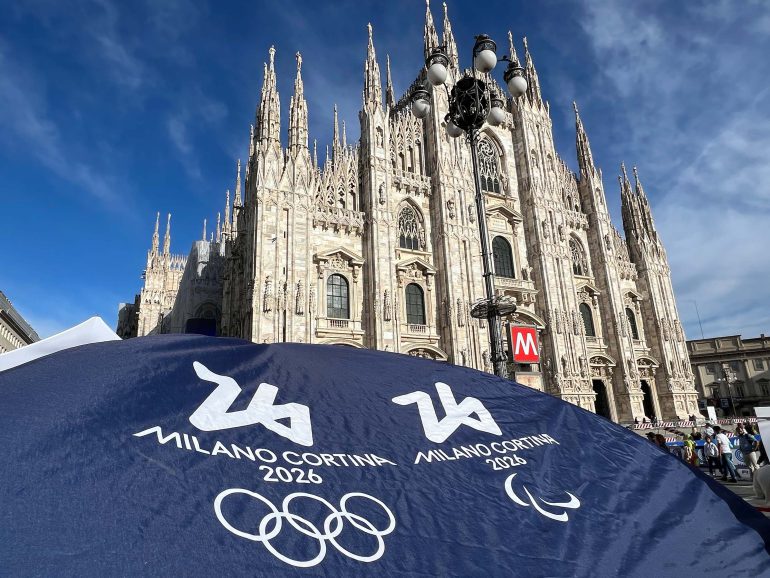
The Winter Olympics have a unique way of pulling people together. Whether you grew up skating on frozen canals, watching alpine races on a Sunday afternoon, or discovering winter sports later in life, the Games offer two weeks of shared drama, beauty and human stories that cross borders with ease. For the international community living in the Netherlands, the 2026 Winter Olympics promise something special: familiar heroes, new stars, and a setting that blends urban flair with classic mountain spectacle.
The next Winter Olympic Games will take place from 6 to 22 February 2026 in Italy, under the banner Milano Cortina 2026. For the first time, the Games will be spread across multiple regions rather than centred on a single compact host. Ice sports will unfold in and around Milan, while alpine events will be staged in Cortina d’Ampezzo and other mountain venues in the Dolomites and northern Italian Alps. Italy has hosted the Winter Games twice before, in Cortina in 1956 and Turin in 2006, but never with this kind of geographic reach. The result is a Games designed to showcase both modern European cities and traditional winter landscapes, with a global television audience firmly in mind.
For expats, the Winter Olympics often resonate more deeply than expected. They offer a chance to cheer for more than one country, to explain unfamiliar sports to friends and children, and to enjoy the simple pleasure of international competition without the intensity that can surround summer football tournaments. Milano Cortina 2026 is also expected to be one of the most watched Winter Games ever, with a packed programme of events and several strong medal contenders across Europe and North America.
Medal prospects always shape the narrative, and this edition is no different. For the Netherlands, the spotlight once again shines brightest on the ice. Dutch speed skating remains the envy of the winter world, and recent championships confirm that the country is still the benchmark in long-track events. In Beijing 2022, the Netherlands topped the speed skating medal table, and projections for 2026 suggest another rich harvest. Short track also offers podium potential, with Dutch skaters firmly among the favourites behind traditional powerhouses like South Korea. Even for non-specialists, orange-clad athletes racing for gold on the oval remain one of the visual signatures of the Winter Games.
Great Britain approaches the Olympics with a more targeted strategy. Rather than chasing medals across dozens of disciplines, Team GB focuses on sports where marginal gains can produce big rewards. Curling remains a stronghold, with British teams consistently competitive against Sweden, Canada and Italy. Skeleton is another key discipline, where British athletes have recently topped World Cup rankings and remain credible medal contenders. While the overall medal count may be modest, Britain’s chances of standing on the podium are very real in these niche but thrilling events.
The United States arrives in Italy as one of the most versatile winter nations. American athletes are expected to challenge for medals across a wide range of sports, from snowboarding and freestyle skiing to figure skating and ice hockey. Analysts consistently place the US among the top three nations overall, even if matching Norway’s sheer volume of medals is a tall order. In figure skating, the Americans are projected to lead the field, while freestyle skiing and snowboarding offer multiple gold-medal opportunities. Add to that the ever-present drama of men’s and women’s ice hockey, and Team USA is set to be a constant presence in prime-time coverage.
Scandinavia, as ever, looms large over the Winter Games. Norway remains the gold standard, particularly in cross-country skiing, biathlon and ski jumping. Predictions once again put the Norwegians at or near the top of the overall medal table, driven by depth rather than dependence on a single superstar. Sweden is expected to shine in cross-country skiing and curling, while Finland’s strengths lie in endurance-based Nordic events and ice hockey. Denmark, though smaller in winter-sport tradition, continues to punch above its weight in selected disciplines and benefits from the region’s strong sporting infrastructure.
Germany’s reputation as a winter sports powerhouse rests heavily on the sliding events, and that tradition looks set to continue in 2026. Bobsleigh, luge and skeleton are disciplines where German teams have dominated recent Olympics and world championships, often sweeping multiple medals in a single event. Beyond the ice tracks, Germany also remains competitive in biathlon, Nordic combined and ski jumping. Few countries combine technical precision and organisational depth as effectively, making Germany a near certainty for a top-tier medal haul.
As host nation, Italy carries both opportunity and pressure. Italian Olympic officials have publicly set a minimum target of 19 medals, an ambitious step up from the 17 won in Beijing. Home advantage is expected to play a significant role, particularly in alpine skiing, short track speed skating and curling, where Italian athletes have enjoyed recent success. There is also excitement around ski mountaineering, which makes its Olympic debut in 2026 and plays directly into Italy’s mountain culture. Even a handful of unexpected podium finishes could propel the hosts into the top five nations, turning local enthusiasm into a national celebration.
Among all these storylines, one athlete stands out as a genuine global star in the making: American speed skater Jordan Stolz. Still in his early twenties, Stolz has already transformed the sport since his Olympic debut as a teenager in Beijing. In the seasons that followed, he collected world titles across the 500, 1000 and 1500 metres, an extraordinary range that recalls the great all-rounders of speed skating history. He has set world and track records, dominated World Cup races, and earned comparisons with legends of the past.
For American fans, those comparisons naturally lead to Dan Jansen, whose emotional Olympic journey defined an era. Stolz’s path is different but potentially just as historic. Where Jansen battled heartbreak before eventual triumph, Stolz arrives in Italy as the man to beat in multiple events. If he delivers on his promise, he could leave Milano Cortina with a medal collection that reshapes expectations for US speed skating and captivates audiences far beyond the ice oval.
For viewers in the Netherlands, following the Games will be easier than ever. NOS will provide extensive free-to-air coverage, particularly of events featuring Dutch athletes, while Eurosport continues to offer wall-to-wall broadcasting across channels and online platforms. Subscribers to Ziggo and KPN can access both domestic and international feeds, and streaming services such as Discovery+ and HBO Max will carry live and on-demand coverage. Those who prefer a British or German perspective can tune into the BBC or ZDF, both of which traditionally offer comprehensive Winter Olympic programming.
As the flame is lit and the first races begin, Milano Cortina 2026 promises two weeks of shared excitement, familiar rivalries and new heroes. Whether you cheer for orange, red, blue or green, these Games invite everyone to be part of the story.
Buon divertimento e godiamoci insieme questi Giochi Olimpici Invernali!
Written by John Mahnen