
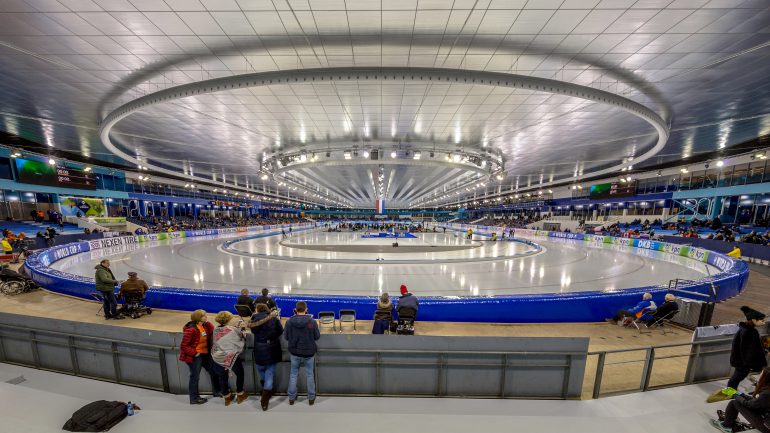
Every winter in the Netherlands, something almost ritualistic returns: Dutch people flock to skating ovals and spend long weekends glued to broadcasts of the world’s best speed skaters, ideally with a steaming cup of snert or hot chocomel close at hand. For expats, this can feel like discovering a parallel universe. Other countries get excited about football or skiing; here, speed skating can dominate the cultural calendar from November to March. And this particular season matters more than most, because all roads lead to the Winter Olympics in Italy later this winter, and the Dutch are determined to arrive in Milan with medals already half-polished in their imagination.
The heart of it all is Thialf, the indoor oval in Heerenveen that many Dutch consider the sport’s high temple. As the latest ISU World Cup event proved, Thialf is more than an arena. It becomes a roaring orange carnival, where crowds sing, dance, and cheer lap times with the intensity normally reserved for international football. Visiting skaters from abroad continue to be floored by just how loud and joyful the Dutch crowd can be. Polonaises snake through the stands, a brass band pumps out party tunes, and at important moments you could almost forget there is ice beneath your feet. Expats who find themselves bewildered by this scene should know: this is normal. And for many Dutch people, it is winter happiness distilled into one noisy, proud, orange-drenched afternoon.
This season has already produced its share of storylines. In the first weekend of December, the ISU World Cup stop in Heerenveen confirmed that the Dutch remain dominant across multiple events. Even with some of the country’s leading names resting to prepare for Olympic qualification, younger skaters have stepped forward. New faces such as Meike Veen and Kim Talsma were selected for the next stage of the World Cup in Hamar, showing just how deep the Dutch reservoir of talent has become. With multiple Olympic quotas already nearly secured and more World Cup points still to be gained, the coming weeks promise intense national interest.
But while the Netherlands celebrates, others are sounding alarm bells. The clearest voice belongs to Norwegian star Peder Kongshaug, currently one of the world’s best 1500-metre skaters. He loves the atmosphere in Thialf, he admits, but he is also pointing out what more and more insiders fear: outside the Netherlands, the sport is struggling. He notes that in places like Salt Lake City, Calgary, Nagano and Poland, crowds can be tiny. Sometimes only a handful of spectators show up for national championships. Where Dutch stadia overflow, other arenas echo. In interviews this winter he has warned that the international federation, the ISU, has allowed the sport to stagnate. He complains of poor global broadcasting decisions, long and complicated event programmes, and a failure to adapt to modern audiences. His criticism is blunt: speed skating cannot survive as a global sport if the Dutch are its only large audience.
Kongshaug’s concerns travel far beyond empty stands. He accuses the federations of focusing too much money and bureaucracy on administrative comforts, not on athletes or promotion. He points to the fact that top skaters earn prize money that has barely increased in decades, while travel budgets remain thin. Even Norway, historically a skating powerhouse, has watched the sport dwindle in popularity and visibility at home. He fears that without fundamental change, it will slowly disappear from public consciousness everywhere except the Netherlands. Some of his proposals are radical: shorter programmes, fewer categories, rotating mid-week evening races broadcast in prime time, even paying national broadcasters to show events. Whether these ideas take hold remains uncertain, but the contrast is striking. Dutch speed skating looks like a party; elsewhere, it resembles a wake.
Why then does the Dutch love affair endure so powerfully? The answer lies partly in geography and history. For centuries, Dutch winters meant frozen canals, and skating was not simply sport, but transport, leisure, romance and national folklore. Legends like Elfstedentocht, the mythical eleven-cities tour, still haunt national imagination even though climate change has made natural ice uncertain. Many Dutch adults learned to skate as children, and many still visit local rinks on weekends. Combine that with near-constant international success and you have a sport that feels deeply personal. Olympic medals in skating are not just sporting triumphs: they are cultural validation.
For expats, the good news is that this obsession is easy to join. Watching a World Cup afternoon at home or in a café is a deeply comforting Dutch winter ritual, complete with warm drinks and cheerful commentary. The rhythm of the races, the repetition of laps, and the tension of the timed format become surprisingly addictive. Even without understanding the technical subtleties, one quickly learns which Dutch skaters to follow, which distances cause the most drama, and why a tiny misstep in turn two can mean Olympic disaster. And if you ever get the chance to visit Thialf, do it. When thousands of people rise to their feet at the start of a race and the music thunders through the hall, you will understand something essential about Dutch joy.
This year all that excitement crescendos toward the Winter Olympics. The Dutch expect medals, and lots of them, and everything in this long season doubles as preparation. Even international skaters admit that the level of competition in the Netherlands is brutally high. Some fear that the imbalance of interest and resources could eventually distort the sport. For now, though, the ride continues. The first cold weekends have arrived, Dutch families are settling in front of the television, children are wobbling on rental skates at local rinks, and colleagues on Monday mornings will compare lap times as casually as conversation about the weather.
Perhaps the most intriguing irony of all is this: while the Dutch throw their hearts into every lap, much of the rest of the world hardly notices. That disconnect may say something about the fragility of winter traditions in a warming, globalised age. But it also highlights something uniquely Dutch. Speed skating remains, at least here, a celebration of movement, community and cold-weather identity. For expats the invitation is wide open: embrace the snert, the chocomel, and the elegant violence of blades on ice. Winter in the Netherlands makes the most sense when you lean into it.
Written by John Mahnen