
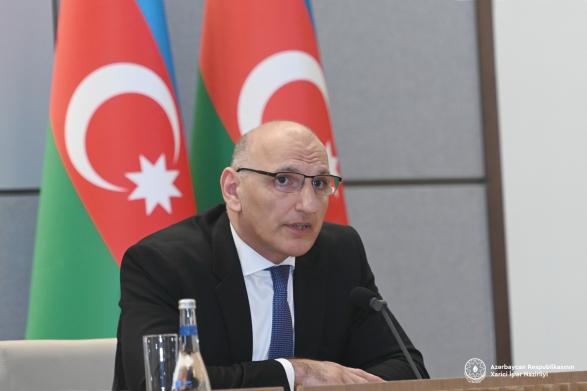
Azerbaijan is setting its sights on expanded international cooperation and regional stability as it charts its strategy for 2026, according to Mr. Elchin Amirbayov, Representative of the President of the Republic of Azerbaijan on Special Assignments. Mr. Amirbayov is currently visiting The Hague as part of the enhanced political dialogue between Azerbaijan and the Netherlands initiated at the beginning of 2025, a visit that also provided the opportunity to meet him for an interview.
Could you outline the key objectives and priorities of your visit to the Netherlands?
This year has been marked by notable dynamism in our bilateral relations. A key milestone was the meeting between President Ilham Aliyev and Prime Minister Dick Schoof on the margins of the European Political Community Summit in Copenhagen. During this meeting, the two leaders discussed various dimensions of our partnership and reached agreements to further strengthen cooperation across a number of areas. In addition, throughout the year our ministers of foreign affairs met on the sidelines of the OSCE Ministerial Council in Vienna, political consultations between the Ministries of Foreign Affairs were held in Baku, and further meetings took place in both Baku and The Hague within the framework of reciprocal visits by deputy foreign ministers and other senior officials. The purpose of my visit is to further contribute to the current positive trajectory and to touch base with our Dutch counterparts on the prospects and plans for the year ahead in order to further deepen our partnership.
Economic cooperation is one of the key pillars of Azerbaijan-Netherlands relations. Trade between the two countries has grown steadily in recent years, increasing by 35 percent during the first ten months of 2025 alone. Mutual investments are also on the rise. Nevertheless, significant untapped potential is still there to further expand and diversify our economic interaction. Azerbaijan is a strategic partner for Europe in contributing to its energy security. Thanks to its geographic location, the country also serves as an important transit hub and lynchpin of connectivity between Europe and Asia and plays a pivotal role in the development and further expansion of the Middle Corridor. Our two countries cooperate closely in the energy sector, including through growing energy supplies from Azerbaijan to the Netherlands. Dutch companies are actively involved in projects at the Port of Baku, including seaport development, shipbuilding, transport logistics, and engineering works aimed at enhancing its capacity as a multimodal transport hub. Looking ahead, future cooperation will focus on the new opportunities in seaport expansion. Agriculture and water management are also potentially key areas of bilateral collaboration. Dutch expertise in sustainable agriculture, greenhouse technologies, and water management can play a vital role in strengthening our economic ties. At the same time, cooperation in high-tech sectors and renewable energy – particularly wind, solar, and green hydrogen – offers promising opportunities to further deepen our partnership.
Enhancing cooperation in culture, education, sports, and tourism is essential for fostering people-to people contacts and mutual understanding. In recent years, collaboration in these areas has gained significant momentum, as also reflected in the growing number of Azerbaijani students studying in the Netherlands.
In light of your recent visit to Brussels, could you share your assessment of the current state and future prospects of Azerbaijan’s cooperation with the EU and NATO?
Indeed, recent discussions in Brussels revealed reciprocal desire to further strengthen and upgrade existing solid ties between Azerbaijan on the hand, and the EU and NATO on the other. It was also a good opportunity to keep our partners abreast of the latest positive dynamics in the process of normalization between Azerbaijan and Armenia as a follow up to a historic breakthrough celebrated earlier this year in Washington. Azerbaijan enjoys quite a rich record of constructive and mutually beneficial engagement with both EU and NATO having earned the reputation of a longtime credible partner of both organizations, be it in the field of energy or security. Today, due to various reasons, including because of the situation in the ground, we believe there are favorable conditions and new opportunities to further expand and deepen our partnership and strategic interaction both with the European Union and with NATO. We therefore hope that the coming year will, in this regard, embody the continued forward-looking development of our relations for the benefit of Azerbaijan and its partners in the EU and NATO.
How would you assess the current regional situation in the aftermath of the Washington summit?
The year 2025 is set to enter history as a genuinely historic milestone, not only for Armenian-Azerbaijani relations, but for the South Caucasus region as a whole. Our countries initialed in August draft peace agreement which, hopefully, could be signed next year. OSCE two weeks ago completed all procedures on the closure of its Minsk Group and related structures, that have become obsolete and dysfunctional since 2020. Our goal is to make sure the peace between our countries is durable and irreversible. To achieve it, constitutional framework of Armenia needs to be brought into compliance with the letter and spirit of the initialed peace agreement, after which it could be signed and ratified by both sides.
The Washington summit between Azerbaijan and Armenia unlocked the door; the responsibility now rests with our countries to construct a durable, secure and prosperous shared future. There is an excellent window of opportunity out there to do that and we sincerely hope that it will not be missed. Lasting peace requires open borders, restored connectivity, and a certain economic interdependence. Connectivity projects – including TRIPP, which is part of a larger Zangezur Corridor – are central to this broader effort to link Europe and Asia through the South Caucasus. These initiatives are crucial for peacebuilding and can create a win-win scenario: Armenia will provide transit between mainland Azerbaijan and its exclave Nakhchivan, while also becoming a constituent part of regional connectivity.
Geopolitical shifts and disruptions along traditional trade routes have bolstered real interest and geoeconomic significance of the Trans-Caspian transportation corridor, otherwise known as the Middle Corridor. Achieving lasting peace between the two countries also requires active diplomacy between societies of Azerbaijan and Armenia which is as important as diplomacy between the governments. And here we also witness heightened activity within the framework of the so-called Track II process, with increasingly frequent exchanges and reciprocal visits involving think tanks, media representatives, and civil society, and this engagement is set to expand further. This is crucial both to build so much needed mutual trust but also to prepare populations who have been leaving for decades in conditions of animosity for peace. As history teaches us, this is a time-consuming process, and one should not expect instant outcomes; nonetheless, it is crucial that, having embarked on this effort, we see it through to the end.
In parallel with these peacebuilding efforts, Azerbaijan undertakes large-scale reconstruction of its conflict-affected territories, which is the top priority of our government. Since the end of 2020 more than 14 bln USD have been spent from the national budget to finance this work. But probably the most difficult challenge that we face is the severe contamination of almost 14 percent of the total territory of our country by landmines and UXOs. Despite enormous efforts for the last five years, up to date we managed to clean up only one-fifth of the contaminated territory. The presence of landmines continues to pose a serious safety concern. Since the ceasefire of November 2020, 414 people have been recorded as landmine victims, with incidents continuing to occur. Needless to say that mine problem significantly slows down the pace of return of almost 800 000 Azerbaijani IDPs back to their homeland. While the Government of Azerbaijan covers 95 percent of all the expenses related to demining, continued solidarity with us on the part of international community, including from the Netherlands, would be highly appreciated.
Written by Nanda Jagusiak-Monteiro